Write 500 words analyzing the role of one character in the novel and how the author uses them to convey ideas about National Identity.
The author uses Captain Antonio Corelli to convey to us the ideas about his national identity. He is an Italian captain in the novel and although the he is the title of the novel, he is introduced very much after the beginning of the book. It is almost half way through the book when he is introduced.
The very first time we read about him is when he orders his platoon to turn their heads and stare at Pelagia, whom he describes as “Bella Bambina.” The actual quote from the book is “Bella Bambina at nine o’clock,” he shouted, “E-y-e-s left.” From this we can see that Corelli was a silly character and also knowing that he is an officer of an invading force, we can see that Italians were disorganized, chaotic and didn’t take this seriously at all.
Before we see this we also see that the Italian army “disembarked apologetically” when they are an invading force and should be authoritative and forceful. This can be seen from “Down in the harbours the men of the Acqui Division disembarked apologetically from their landing craft and waved cheerfully but diffidently to the people in the doorways.” They are the exact opposite of the German army. They are cheerful when they are entering an island which they must conquer and the soldiers are waving at the local people. We also see that there was no organization or planning before the invasion of the island. We can also see that they are very relaxed and are ambling by. This can all be seen from “platoons of paratroopers ambling by, their commanders consulting maps”. This gives us an idea of how a typical Italian soldier would be. From this we can infer that the Italians are humorous people who do not take things very seriously.
From all the information we see about the Italian invasion force and the national identity of Italians match to Corelli. Corelli’s role in the book is the person who replaces the people who 2 other characters loved. Firstly there is Carlo, who loved Francesco but now loves Corelli and secondly there is Pelagia, who loved Mandras previously but now loves Corelli. In this role he shows us his national identity both when he is with Carlo and when he is with Pelagia.
Firstly, when he is with Carlo and his platoon, he had created “La Scala” which is a group of his soldiers who meet and sing in the latrines. This shows us a kind of comical view of Corelli and his platoon. Corelli had even made rankings with musical terms such as ‘breve’ or ‘semibreve’. Also, in Carlo’s description of Corelli, we can see that he doesn’t take life very seriously, carefree, humorous and exaggerated. We can also see that he is flamboyant and that he loves children, women and singing. This can bee seen from “prone to dramatic exaggeration….always larger than his circumstance….say things for the sake of their value as amusement, with an ironic disregard for the truth…observed life with raised eyebrows…..had none of that fragile self-pride that prevents a man from telling jokes against himself.” And “He adored children, and I saw him kiss a little girl on the head…..he loved to make pretty women giggle by snapping his heels together and saluting them with a military precision so consummate that it came over as a mockery of everything soldierly….His battery had a latrine known as ‘La Scala’ because he had a little opera club that shat together there at the same time every morning”.
Secondly, when Corelli is with Pelagia, he is always making her laugh and never gets angry at her no matter how hard she tries. For example, when Pelagia soaked his pistol in water to make it rust and was caught, “her heart galloped painfully with fear and anxiety” but Corelli didn’t give the reaction Pelagia wanted. He just said “I suppose you have done me a favor. I should have dismantled it for cleaning and oiling a long time ago” and lets it pass. He doesn’t take this seriously and punish Pelagia. Also he acts silly around her. Some examples are when he “tied a cork to a piece of strinf, and sprinted about the house with Psipsina in hot pursuit” and when he “sprang dancing to his feet, capering ridiculously and crying ‘I won, I won’”.
Therefore, the author uses Corelli’s role in the novel to show us the national identity of a typical Italian.
skip to main |
skip to sidebar

HIGHER LEVEL

STATISTICS OF WW1
Russia mobilised 12 million men during the war;
France 8.4 million;
Britain 8.9 million;
Germany 11 million;
Austria-Hungary 7.8 million;
Italy 5.6 million;
USA 4.3 million.
8,538,315 were either killed or they died.
21,219,452 were wounded.
7,750,919 were made prisoners.
So, the total casualties of World War 1 were 37,508,686
More German soldiers were killed than any other nation in WW1.
France 8.4 million;
Britain 8.9 million;
Germany 11 million;
Austria-Hungary 7.8 million;
Italy 5.6 million;
USA 4.3 million.
8,538,315 were either killed or they died.
21,219,452 were wounded.
7,750,919 were made prisoners.
So, the total casualties of World War 1 were 37,508,686
More German soldiers were killed than any other nation in WW1.
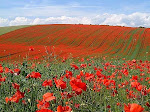
Poppy Field
In Flanders Fields
In Flanders Fields the poppies blow
Between the crosses row on row,
That mark our place; and in the sky
The larks, still bravely singing, fly
Scarce heard amid the guns below.
We are the Dead. Short days ago
We lived, felt dawn, saw sunset glow,
Loved and were loved, and now we lie
In Flanders fields.
Take up our quarrel with the foe:
To you from failing hands we throw
The torch; be yours to hold it high.
If ye break faith with us who die
We shall not sleep, though poppies grow
In Flanders fields.
Lieutenant Colonel John McCrae, MD (1872-1918)
Between the crosses row on row,
That mark our place; and in the sky
The larks, still bravely singing, fly
Scarce heard amid the guns below.
We are the Dead. Short days ago
We lived, felt dawn, saw sunset glow,
Loved and were loved, and now we lie
In Flanders fields.
Take up our quarrel with the foe:
To you from failing hands we throw
The torch; be yours to hold it high.
If ye break faith with us who die
We shall not sleep, though poppies grow
In Flanders fields.
Lieutenant Colonel John McCrae, MD (1872-1918)
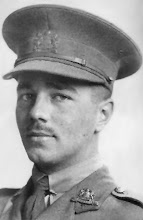
Siegfried Sassoon
Wilfred Owen
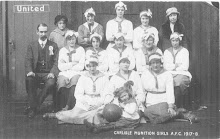
Munitions Girls
Blog Archive
IB ENGLISH A1 HIGHER LEVEL AT BIS VIETNAM
Considering the human experience through Love and War.
2 comments:
You are currently working well, Daniel. You have some good ideas and are beginning to analyse effectively.
Perhaps you could comment on how DeBernieres uses language to show how Corelli is such a vibrant and flambouyant character - look closely at word choices and sentence construction.
In the novel Captain Corelli by Louis de Bernieres, the idea of national identity plays and important role in the way in which the characters are presented. One of these characters in which National Identity was presented is Captain Corelli.
One of the most common characteristics of Italian stereotyping is the idea of romance; an Italian stereotypically would be expected to be romantic towards the women. One way in which de Bernieres presents this is during the Italian army’s landing on Greece. As walking past Pelagia, Corelli shouts out to his men for look at the “bella bambina at nine o’clock”. The fact that the author chose for the character to say it in Italian, their native language and not in English creates more emphasis that Italians in particular are natural romantics, noticing beautiful women even during an invasion.
Another stereotypical point in which de Bernieres uses to portray the image of Corelli as a real Italian is by the way in which he perceives the world, not taking things in life and life itself too seriously. One way in which this is shown is by having the character of Carlo describe Corelli how he “observed life with raised eyebrows”, suggesting how he never took things seriously as most people, as raised eyebrows often represent a questioning and relaxed attitudes. Also, de Bernieres shows the reader how the Captain manages to find fun and happiness in every aspects of life. The fact he is “conducting the concert with the aid of a feather in his right hand” shows that he is a fun and enjoyable character to be around. What is really surprising is that not only this fun time he is having with his men is in the toilet areas every morning, but also that he was the highest ranking officer there, which means that he is supposed to set a good example to his men, not encouraging to act in such manners. This shows the reader how little Corelli, which represents Italians in general through stereotyping always find that they can have fun and enjoy life, wherever they might be, whoever they might be with and whatever their ranks.
In addition to the Italian idea of fun in life, one important aspect is also their love for music and how it plays an important role in their daily lives. This is presented to the reader when de Bernieres introduced “la Scala” named after the opera house in Milan Italy, through Carlo’s narration. It was the nickname given Corelli’s daily morning concerts in the toilets. The music played in the morning has become part of the soldiers’ daily lives in the camp and become almost essential to the well-being of the soldiers, just like music has been associated to the Italians’ way of life. Music also plays a very important role through the character Corelli and his mandolin.
It can be concluded that the author presented Corelli and his mandolin in such way that he has become a representation of his people and their way of life.
Post a Comment