Saturday, September 19, 2009
Social traditional barriers eradicated during WW1
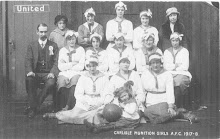
In “Regeneration”, the reader will come across three very prevalent themes that are associated with expansion and eradication of traditional social barriers in the midst of World War 1. The three themes are Emasculation, Women’s Roles and Sexual Independence. During The Great War, the views, situations and roles had changed. When war broke out, women may not have been ebullient to send their beloved sons and husbands to war, but in a peculiar way, they were content with the war because they experienced a liberation they never experienced before, they were now the only people left to run factories, and they were responsible for their own lives and this made them feel powerful and this also instilled male characteristics in them, mostly in the lower/working class. So even though war brought death and destruction for men, it brought about liberation for women. We begin to see that women evolved in such a way because they didn’t want to go back to being submissive wives, they wouldn’t let their freedom be taken away so conveniently. Women slowly realized that they could establish their own life single-handedly outside of their home-makers role, “six days a week, but she liked to work.” And Barker sheds light on this through the following, “The smell of steak frying reminded him of home….” Here we see that Barker first establishes how the women were meant to behave in a traditional manner, but to follow that up, Barker uses Prior to go into a pub and chance upon a few middle aged and older women sitting there. And here Barker uses the phrase “a group of women, thirty or forty perhaps sitting on the next table. “ So here we see that FIRST Barker states clearly the expected role of women, but war brought about change and unexpected joy for women and hence, one would know find a traditional social barrier eradicated. It is eradicated because Barker sheds light on the fact that these women are now finally going out, and they aren’t just cooking for themselves, they are ordering food and socializing in a ‘mans’ place. And not only are these women young, but this war has united all women from all ages. The phrase “Lizzy was keeping these young girls entertained…” further emphasizes the fact that, prior to the war, these women were walking cardboard boxes with no experiences of their own, but now they had stories to tell, they had personalities to exuberate and they had responsibilities of their own. Also, traditional barriers to equality between the two sexes was eradicated, “She held her hand out to him in a direct way…” the aforementioned phrase sheds light on how women are now, during the war, perceived as no longer the lower sex and are now behaving openly in more boyish manners. In fact, almost everywhere one went, they were seeing how women were growing in confidence, women go out and “burst out into minor explosions of giggles” and have fun and they fall “in with the other girls” because, now society lacks the male presence and women have taken over every aspect of life back home. Although they aren’t fully adjusted to it, “Subdued, they hadn’t yet managed to adjust”, but they won’t give it up no matter, because even if they are working hard, they “appear to be jolly” even if they are in bad working conditions. Also, Barker uses Sarah and her girls to discuss Betty’s alleged abortion and this sheds light on how traditional social ideologies have been eradicated and in place of them, women push aside the idea of “the sole purpose of life being the need to reproduce” but rather, being open to abortion and contraceptives because this new role to them was much more exciting than being a ‘home-maker’ again. Also, not only did women become overly confident, they also indulged in open discussions about sex and were sexually independent. Something they wouldn’t have been prior to the war, Barker uses Sarah to emphasize on how women were approaching men openly and were being flirtacious and drinking one drink after the other. Also, they were openly discussing sex lives and indulging in vulgar, coarse, brash and sexual discussions, “arseholes, bugger”, “he went to the club”, even homosexuality which was taboo to discuss, was openly debated. And this sexual liberation sheds light on how they’ve lost their respect for men. “Raucous laughter” is a phrase that Barker uses to suggest the type of masculinity and vulgarity that encapsulates these women and how they have become, contrary to what pre-war society wanted them to be, sexual and otherwise independent.

Subscribe to:
Post Comments (Atom)



1 comment:
Post a Comment